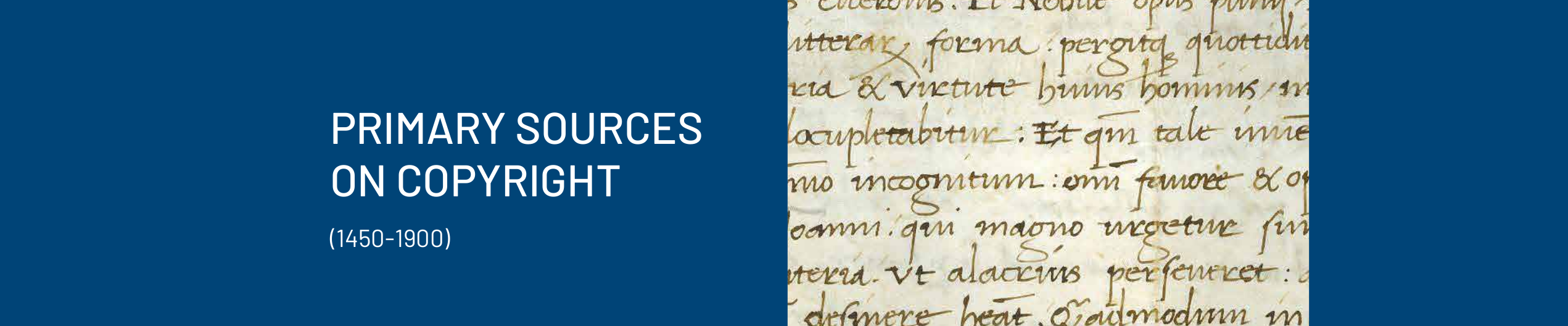




This is a digital archive of primary sources on copyright from the invention of the printing press (c. 1450) to the Berne Convention (1886) and beyond. The UK Arts and Humanities Research Council (AHRC) funded the initial phase (completed in 2008 with a launch conference at Stationers’ Hall). This focussed on key materials from Renaissance Italy (Venice, Rome), France, the German speaking countries, Britain and the United States.
We continue to add new materials. Primary sources from Spain (edited by José Bellido) were published in 2012; the Netherlands followed in 2015 (edited by Stef van Gompel and Marius Buning). Jewish Law sources (edited by Neil Netanel), were published in 2016. In 2018, Elena Cooper joined Ronan Deazley as editor of the British sources, adding documents concerning the visual arts in the nineteenth century. From 2019, Portuguese and Brazilian sources were added by Patrícia Akester and Victor Drummond. In 2021, Jane Ginsburg started to edit a selection of Vatican documents, due to be completed in 2023. In 2023, Marius Buning was appointed editor for Scandinavia. Following a conference with the national editors in Glasgow in October 2023, Katie Scott and Amy Thomas were appointed co-editors for France and Scotland and a managing board was constituted.
The national editors are:
Britain: | Professor Ronan Deazley (2008-2018), Independent researcher (formerly University of Glasgow) |
German speaking countries: | Dr Friedemann Kawohl, Independent researcher (University of Glasgow) |
France: | Dr Frédéric Rideau, Université de Poitiers |
Italy: | Dr Joanna Kostylo, Jagiellonian University |
Jewish Law: | Professor Neil W. Netanel, University of California at Los Angeles |
Netherlands: | Professor Stef van Gompel, Vrije Universiteit Amsterdam |
Portugal and Brazil: | Patrícia Akester, PhD, Independent researcher (University of Cambridge) |
Scandinavia: | Dr Marius Buning, University of Oslo |
Spain: | Dr José Bellido, University of Kent |
United States: | Professor Oren Bracha, University of Texas |
Vatican: | Professor Jane C. Ginsburg, Columbia University |
Managing board:
Lionel Bently, Marius Buning, Elena Cooper, Martin Kretschmer (chair), Bartolomeo Meletti
In 2010, Cambridge based publisher OpenBook published a companion volume to the digital archive: "Privilege and Property, Essays on the History of Copyright", containing an introductory essay by the editors: The History of Copyright History.
Following the launch of the project at Stationers’ Hall in London on 19 March 2008, we promised that the URLs for the documents in the archive would be permanent (permalinks). Document links to the first version of this database (pre-2012) will continue to be redirected to the correct documents.
The original database design and website were coded by Karin Hoehne (Cologne). Redesigns were implemented in 2012, in 2015 and 2024. The functionality now provides an OAI/PMH data interface delivering record data as Dublin Core. Please refer to the FAQ section for information about accessing the interface.
Please cite this resource as:
Primary Sources on Copyright (1450-1900), eds L. Bently & M. Kretschmer, www.copyrighthistory.orgProfessor Lionel Bently, University of Cambridge
Professor Martin Kretschmer, CREATe, University of Glasgow
General Editors, Primary Sources on Copyright
The website should be compatible with any modern internet browser since we follow standard HTML conventions without usage of HTML5. We might switch to HTML5 integration in the future. Updating older browsers is recommended.
Please report technical issues or errors to Bartolomeo Meletti (Bartolomeo.Meletti[at]glasgow.ac.uk).